



About the Customer
The client is one of the largest insurance companies in the United States. Their subsidiaries provide insurance, investment management, and other financial services to both retail and institutional customers throughout the United States and 40 other countries around the globe.
Key Challenge/Problem Statement
The client faced significant challenges in their efforts to streamline and enhance their machine learning application delivery. The primary issue was the lack of a cohesive pipeline strategy and application development framework to support both generative and traditional machine learning models. This gap resulted in disparate team efforts, leading to duplication of work and inefficiencies across the organization.
Fragmentation not only led to redundancy in effort but also posed risks related to data governance and compliance, as there was no centralized mechanism to control access and permissions across different data sets and applications. The client had been seeking a means to create a better data authorization framework, and SageMaker Unified Studio, or Datazone was perfectly positioned to provide solution. VR developed both pipeline and data strategies to ensure effective deployment and iteration of a Datazone ecosystem that would support the client’s goals with bleeding edge AWS AI offerings.
State of Customer’s Business Prior to Engagement
Before Vertical Relevance’s engagement, the client faced significant challenges in their approach to developing, sharing, and deploying machine learning applications. The primary issue was the lack of a cohesive pipeline strategy and development frameworks for their machine learning initiatives, both generative and traditional. This absence of a unified approach led to numerous inefficiencies and duplicated efforts across the organization.
Furthermore, there was a significant conflict between the client’s Core DevOps team and other departments, as multiple groups independently attempted to create their own pipeline strategies for similar problem spaces. This lack of coordination resulted in fragmented efforts and a proliferation of redundant solutions, wasting both time and resources.
The client’s existing machine learning development environment was also inadequate. They were heavily reliant on SageMaker Classic as a crutch. Too many needed development features were missing, reducing adoption, and further fragmenting development patterns.
The client’s enterprise data-sharing practices were another area of concern. Their platform struggled with attributing permissions and safeguarding data during application sharing. This issue was compounded by the need for certain teams to access specific datasets while restricting others, leading to complex and inefficient data management practices.
Overall, the client required an enterprise-wide standard to reduce waste across the organization. Machine learning development standards needed updates to meet the pace of AI development at enterprise scales. Most importantly, data compliance was a major concern where AI data protection needed safeguards that were lagging across the organization.
Proposed Solution & Architecture
The solution we proposed for the client aimed to address their need for a cohesive and standardized pipeline strategy for deploying machine learning applications, both generative and traditional. Our approach centered around implementing Amazon SageMaker Unified Studio, leveraging its capabilities to create an enterprise-wide platform that fosters visibility, collaboration, and efficiency across multiple lines of business. This solution was designed to overcome the prevalent issue of duplicated efforts within the client by providing a centralized, accessible catalog of machine learning assets, enabling teams to share and discover resources efficiently.
The first focus delivered a notebook standardization for the client. This included developing new IaC standards to support Datazone. IaC supplemented Datazone to supply post-deployment infrastructure management to enable customer solutions within notebooks. We also developed a novel means to implement Docker due to the AWS service account structure implemented in Sagemaker.
The second focus was providing a data catalog and a scalable means to implement this the client wide. This included strategy to progress the granularity of controls as the product progressed while remaining compatible with previously provisioned data catalog products. This required interdepartmental solutioning to meet requirements held by the client as a whole.
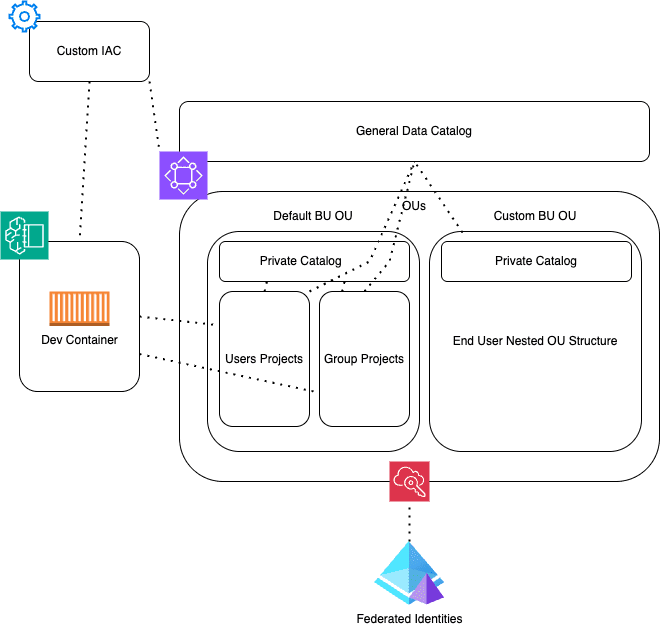
Figure-01
AWS Services Used
AWS Storage Services – S3
AWS Networking Services – VPC
AWS Management and Governance Services – AWS Service Catalog, Amazon DataZone
AWS Security, Identity, Compliance Services – IAM
AWS Containers – Amazon Elastic Container Registry
AWS Database – RDS
AWS Machine Learning – Bedrock, SageMaker Unified Studio, Datazone
Outcome Metrics
- Offered a 30% reduction in duplicated efforts across the client by implementing SageMaker Unified Studio, which provided a centralized platform for sharing and discovering machine learning assets
- Initial offering was adopted by 4 lines of business
- Enabled seamless enterprise-wide data sharing and access control, improving data governance and reducing data management complexities for multiple business units
- Facilitated the transition from SageMaker Classic to SageMaker Unified Studio, offering a 25% increase in developer productivity by streamlining the machine learning development environment
- Enhanced cross-team collaboration and innovation by establishing a client-wide catalog, allowing teams to easily publish and access machine learning applications and resources
- Demonstrated the feasibility of AWS DataZone integration, providing a blueprint for future infrastructure as code strategies and increasing the efficiency of resource provisioning
- Improved utilization of AWS services, including Bedrock, by configuring DataZone to enable comprehensive access, thereby enhancing the overall machine learning development experience
- Offering reduced onboarding time for new developers by 40% by creating a unified developer ecosystem with pre-configured tools and environments tailored to the client’s needs
Lessons Learned
While the project did involve some manual configuration processes, discovering more opportunities for automation could enhance efficiency and reduce the potential for human error. This could involve automating all configuration of DataZone and other AWS services to streamline deployment and management processes.
Summary
The engagement with the client culminated in the successful implementation of SageMaker Unified Studio, which significantly enhanced their machine learning development environment. By overcoming initial challenges and pivoting to align with the client approach, Vertical Relevance was instrumental in establishing an enterprise-wide platform that streamlined the development and deployment of machine learning applications. The newly implemented system allowed for seamless integration and visibility across multiple lines of business, reducing the duplication of efforts and fostering a collaborative environment.
The deployment of SageMaker Unified Studio provided the client with a robust framework for managing enterprise data sharing and access permissions. This also empowered teams to efficiently utilize AWS services such as Bedrock and SageMaker, within a Docker-based development environment, thereby abstracting complex AWS interactions and enabling a user-friendly developer experience. As a result, the client achieved enhanced productivity and innovation in their AI/ML initiatives, while ensuring compliance and security through a well-structured data governance model. The project not only addressed immediate technical challenges but also positioned the client for future growth by establishing a scalable and flexible infrastructure for their machine learning operations.